On 10 May, Facilitators Network Singapore hosted a Community of Practice session titled A Pen. A Picture. A Strategy. Co-led by Tina Wong and Goh Ai Yat, the workshop invited facilitators, educators, and consultants to rethink how they use visuals to improve clarity, communication, and comprehension in their facilitation and training work and how they approach problem-solving by making thinking visible.
The core message was clear:
Visual thinking is not about artistic talent. It is a thinking skill.
Part 1: Tina Wong – Drawing to Think, Not to Impress
Tina Wong opened the session by challenging a limiting belief: “I can’t draw.”
She shared her journey from self-doubt to confidence, where stick figures, once considered too simple, became useful communication tools in her visual facilitation work. One client even had them printed as stickers for international students. The lesson was simple:
“We draw to communicate ideas. Not to discuss the drawing.”

She invited everyone into a No Judgement Zone, a safe space where clarity mattered more than correctness. Through simple visual prompts, participants introduced themselves using only drawings of their favourite food, hobbies, or destinations. These sketches helped participants connect more naturally and focus on expressing ideas.
Next, Tina introduced five basic elements that make up most visuals: lines, circles, squares, triangles, and dots. Participants were guided to combine these into images and metaphors. Drawing became structured. Ideas became visual. The process sparked curiosity and confidence.
As one participant shared:
“What struck me most? Simplicity and connection are key.”
Part 2: Goh Ai Yat – Strategy Begins with a Sketch
Following Tina’s session, Goh Ai Yat shifted the focus from expression to strategy, demonstrating how visual thinking enables clarity and decision-making in real-time.
She began by showing how our visual processing is faster than verbal reasoning. Understanding how we see can improve how we think, especially under pressure.
Ai Yat then shared a personal story from 2020. When the pandemic hit, her training work was cancelled indefinitely. For three months, there was no revenue and no clarity about what came next. At 63, retirement seemed like a practical choice.
But instead of walking away, she turned to the tool she had been teaching for years: the <6><6> Visual Thinking Framework.
Using visual mapping, she asked herself two questions:
Where am I now?
Where do I need to be?
With her radar map drawn, the gaps were clear and painful. Her business was not ready for the new reality’s online demands. She contacted clients to find out what they needed. Their answer was direct: experienced trainers who could adapt and deliver online with impact. Many of her peers hesitated to make the leap. She saw an opportunity.
She sketched the gaps. The gaps clarified action.
She repositioned her business and eventually co-authored a national bestseller, The S.T.A.R. System – Applied Visual Thinking for Career and Business Success.
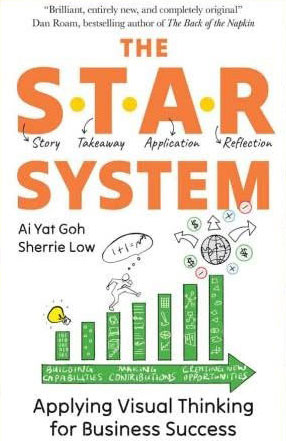
Visuals drawn. Gaps identified. Action taken.
The sketchpad not only helped her reflect. It enabled her to reset.
Frameworks That Shift Thinking
Two thinking tools underpinned the session, applied live, not just explained:
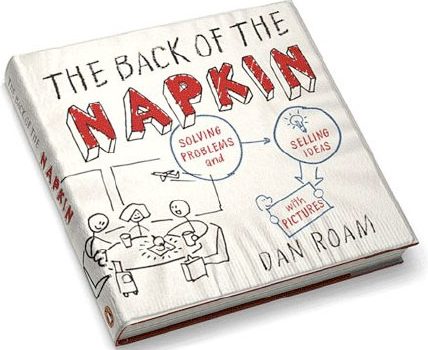
The <6><6> Framework by Dan Roam
A practical tool that breaks down complex problems using six core questions: Who or What, How Much, Where, When, How, and Why, paired with six types of visuals. This combination helps surface blind spots, sharpen insights, and prompt action.
The S.T.A.R. System
A structured approach to building resilience in your career and business:
- Story – Look better at business stories to gain insights
- Takeaway – See sharper takeaways to drive change
- Application – Imagine further cross-industry applications for possible solutions
- Reflection – Show clearer reflections for successful implementation
These were not theoretical frameworks. Participants used them to analyse real-world examples, such as how Nestlé pivoted into pet care by observing shifting consumer behaviours and applying visual clarity to business strategy.
As one participant reflected:
“Mind officially blown by the potential of visual thinking for problem-solving and making strategic pivots.”
Final Reflection: Clarity Over Perfection
This was not a drawing class. It was a thinking workshop.
A place where visuals helped reveal assumptions
Where sketching replaced over-analysis
And where simple tools reframed complex decisions
You do not need to be an artist.
You need structure, willingness, and a pen.
Sometimes, the fastest way to move forward is to see the problem from a different perspective.
By Line
This article was contributed by Tina Wong and Goh Ai Yat.
Tina Wong drives impact through play, insights through visuals, and wellness through balance. Connect with Tina at linkedin.com/in/tinawongcy
Ai Yat is a Visual Thinking Strategist, Speaker, Master Trainer andCo-Author of The STAR System. She helps professionals and businesses see gaps, opportunities, and solutions clearly through visual strategy. Connect with Ai Yat at linkedin.com/in/aiyatgoh
Wished you were at this CoP?
Don’t miss our next CoP. Check our website at https://fns.sg/forums/ for updates and details.
And you do not want to miss our upcoming conference on
5-7 November 2025
“Facilitation in Action: Partnering for Transformation and a Sustainable Future”.
Check our website for more information and registration at https://fns.sg/singapore-facilitation-conference-2025/.