Designing the Future Together: A Search Conference Experience
When it comes to group transformation, many of us speak about the future as something that happens to us. But what if the future could be shaped by us, together?
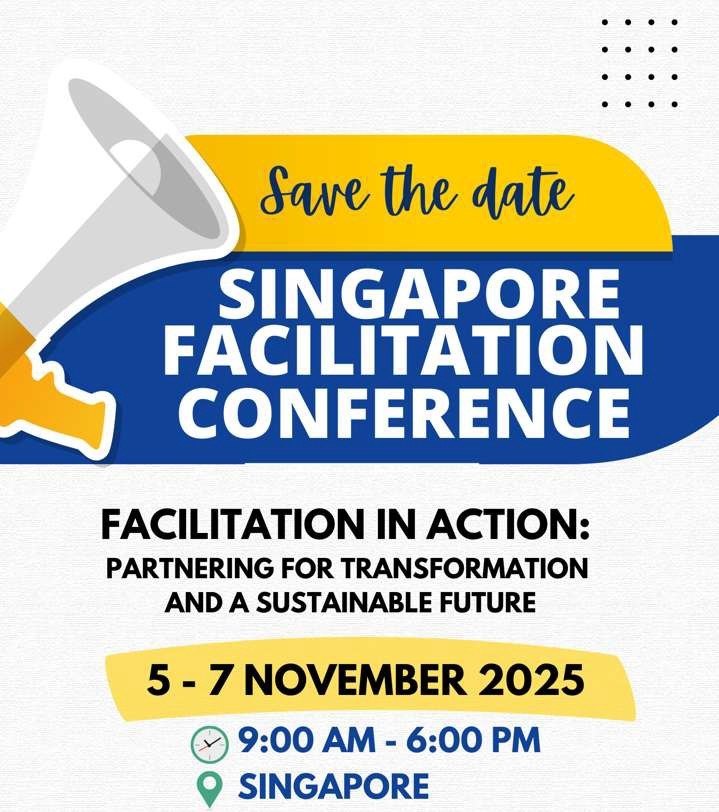
In a full-house session on the morning of the final day of the Singapore Facilitation Conference (SFC) on 7 November 2025, participants had the opportunity to experience a taste of the Search Conference, a facilitation method grounded in open systems thinking and democratic design. The session was led by Janice Lua, Co-Founder of Facilitators Network Singapore, whose clarity, and command of the process held the space for 2.5 transformative hours of deep participative planning.
What is a Search Conference? A Planning Process for Human Futures
The session was based on the book The Search Conference: A Powerful Method for Planning Organisational Change and Community Action by Merrelyn Emery and Ronald E. Purser, a foundational text for large group facilitation.
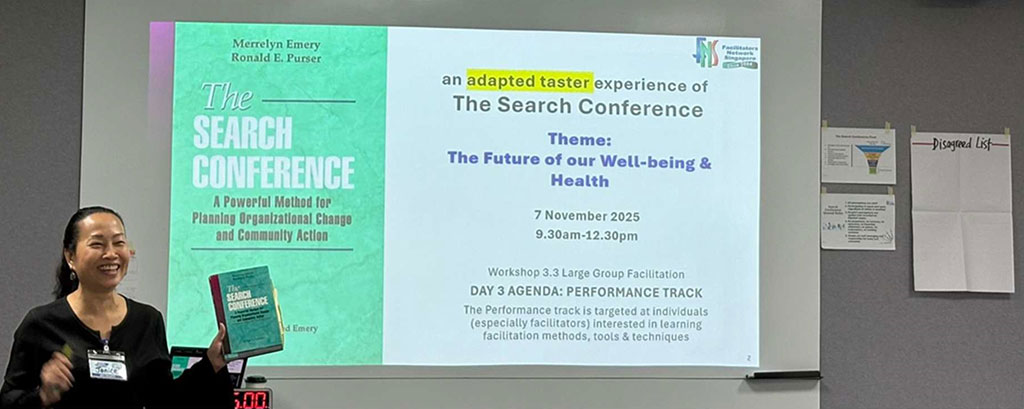
The book provides a structured, participative planning methodology. It is designed for communities and organisations to scan their environment, explore their system’s past and present, define a desirable future, and commit to concrete action.
Rather than following a formula, Janice emphasised the application of principles, echoing the quote by Julia Child shared during the session:
“Good cooks do not follow recipes. They use principles.”
We were reminded that effective facilitation is not about applying rigid tools, but the ability to create emergence, trust, and shared ownership.
What Makes the Search Conference Unique?
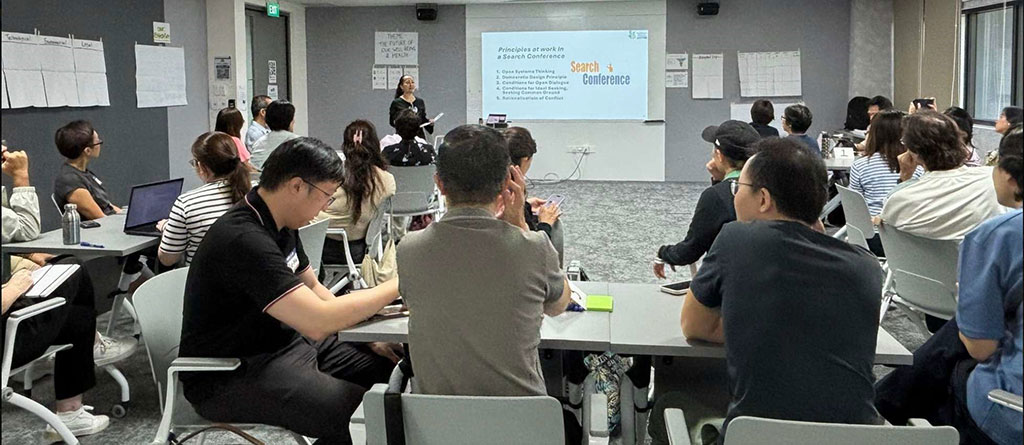
Janice walked us through the five key principles that underpin the search conference model:
- Open systems thinking – every group is part of a larger environment.
- Democratic design – content comes from participants, not the facilitator.
- Conditions for open dialogue – safety, sequencing, and surfacing.
- Ideal-seeking and common ground – move toward what is desirable, not just doable.
- Rationalisation of conflict – see disagreement as data, not danger.
Theme Setting: The Future of Our Well-being and Health
The working theme of the session was “The Future of Our Well-being and Health.” This gave the group a meaningful and relatable topic through which to explore facilitation techniques. Participants reflected on what well-being means at the individual and systemic level, from access to clean water, to healthier urban lifestyles, to creating emotionally safe workplaces and healthier social media use. This theme lent focus to the conversations and surfaced ideas with real-world resonance.
A Democratic Planning Experience
One of the most striking aspects of the session was its democratic design. No subject matter expert stood in front to deliver a lecture. Instead, the participants owned the content, shaped the priorities, and voiced what mattered to them.
Janice reminded us that in a true Search Conference, facilitators design the process and learning environment but step out of the way when it comes to outcomes. This keeps the focus on self-managed groups, equality of voice, and shared responsibility.
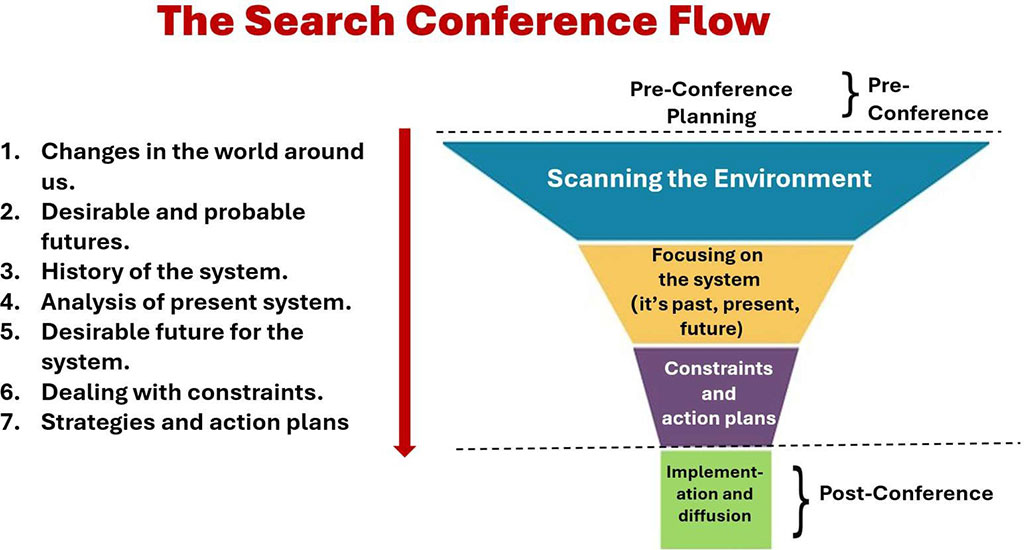
The diagram below illustrates the typical flow of a full Search Conference. From pre-conference preparation to post-conference implementation, each phase is carefully designed to guide participants from environmental awareness to collective action. The process helps groups move from exploring external trends and internal dynamics to identifying constraints, setting priorities, and committing to shared goals.
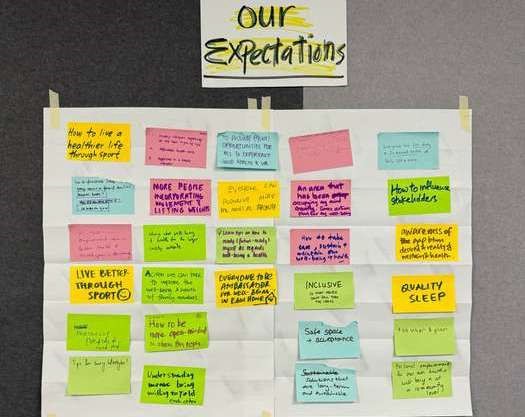
Expectations
The conference started with Janice inviting the participants to share their expectations of the conference theme.
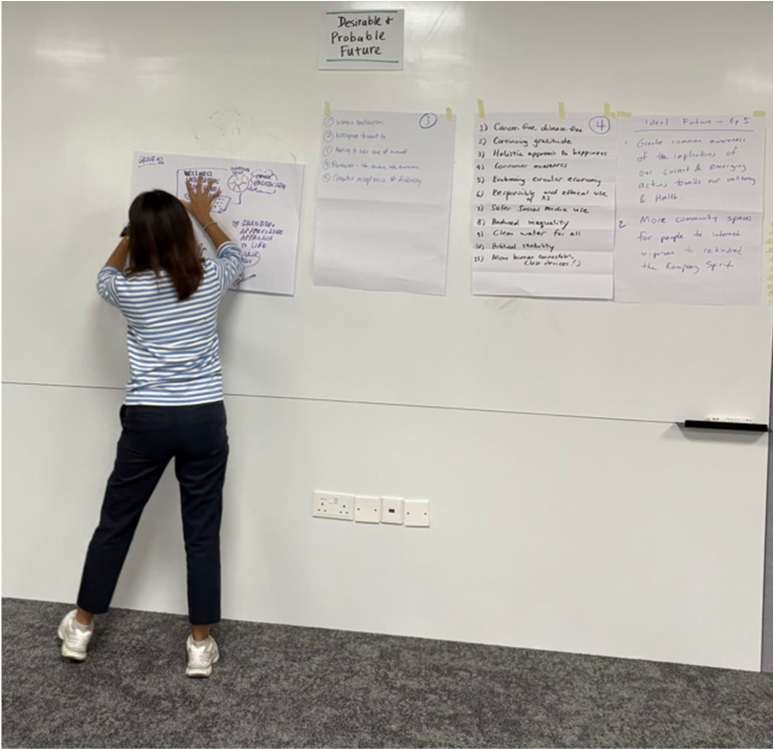
Desirable and probable future
One of the pivotal activities in the session was the “desirable and probable future” exercise. We worked in small groups to imagine what the future of well-being and health could look like. Ideas ranged from practical solutions such as improved healthcare access, to more aspirational hopes like “greater empathy in leadership.”
This exercise marked a shift, from describing the system to imagining what it could become. It reminded us that the space between what is likely and what is desirable is where meaningful planning begins.
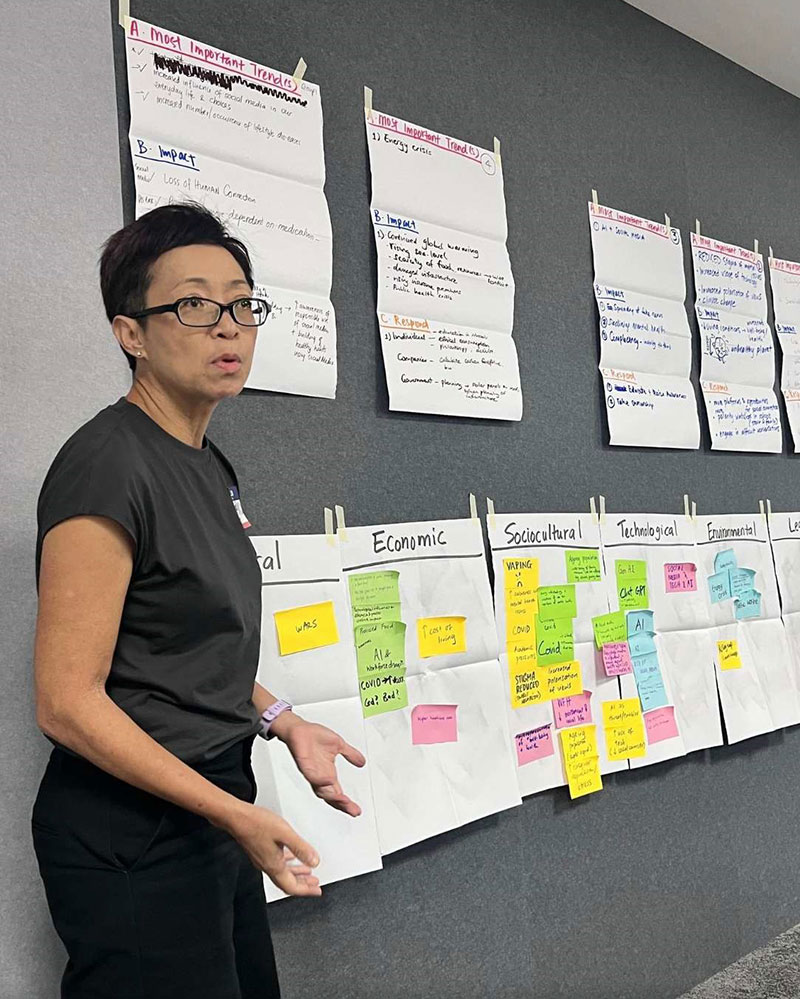
PESTEL
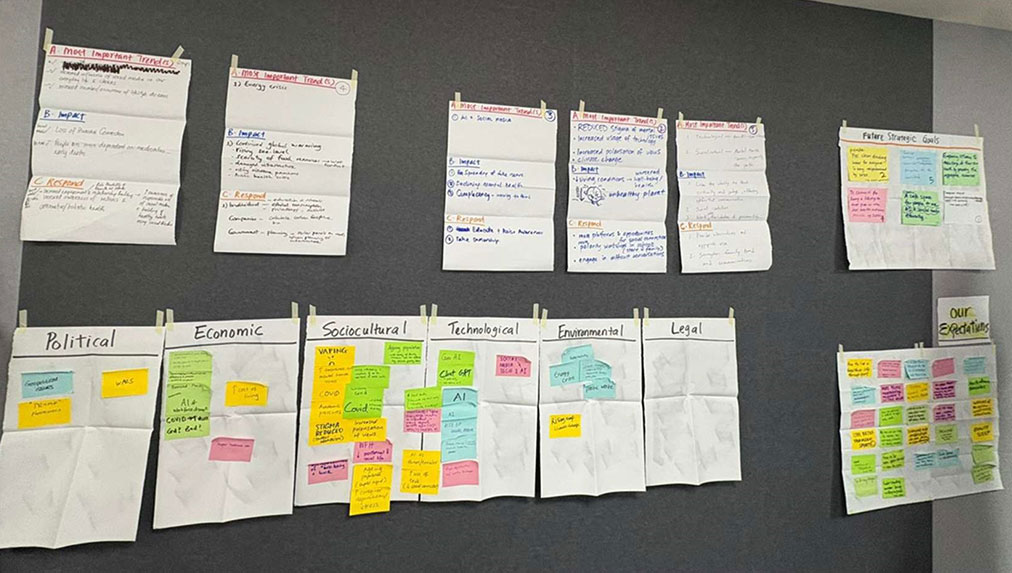
From there, we scanned the environment using the PESTEL (Political, Economic, Sociocultural, Technological, Environmental and Legal) framework, filling the wall with sticky notes that named systemic trends. AI disruption, climate anxiety, digital fatigue, and mental health were just a few of the issues surfaced.
Conflict and Difference: Framed as Insight, Not Obstacle
A particularly powerful idea from the session was that conflict is not something to resolve quickly, but a source of useful information. Rather than defaulting to compromise or silence, the search conference method encourages rationalising conflict, seeing it as data, not danger. Disagreements are debated and negotiated before putting them on a Disagreed List.
Zeigarnik Effect
This moment also surfaced one of the search conference’s other principles, the Zeigarnik effect. This psychological phenomenon stems from the tendency of the brain to maintain a state of tension with unfinished tasks, which keeps them more easily recalled than tasks that have been resolved and are no longer on the mind.
Looking Back to Look Forward
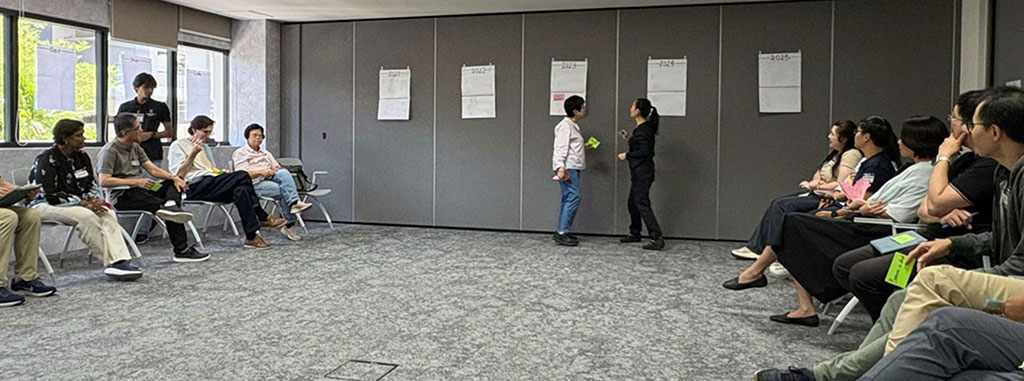
We also reflected on our own journeys on a from 2022 to 2025, placing high points above the line and challenges below on a shared timeline. The simple act of naming personal moments sparked connection and empathy in the room. It set the tone for honest dialogue and reminded us that meaningful planning starts with shared understanding.
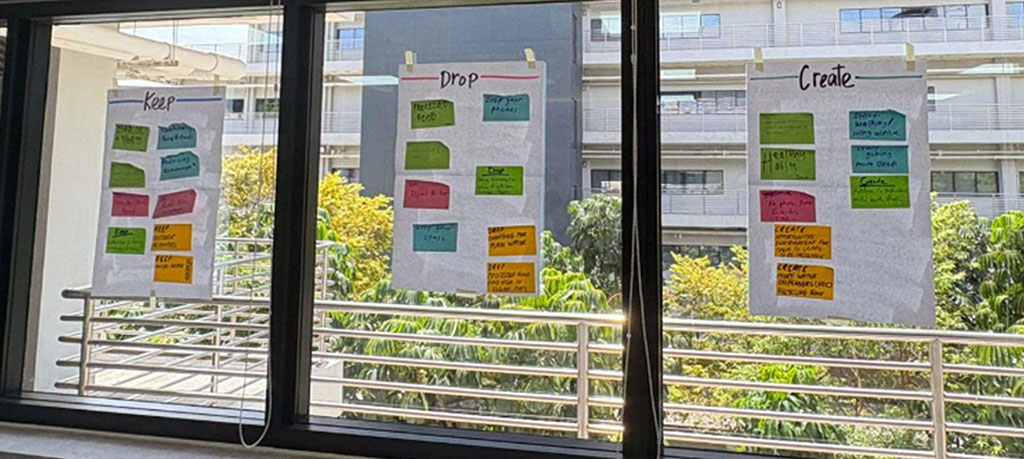
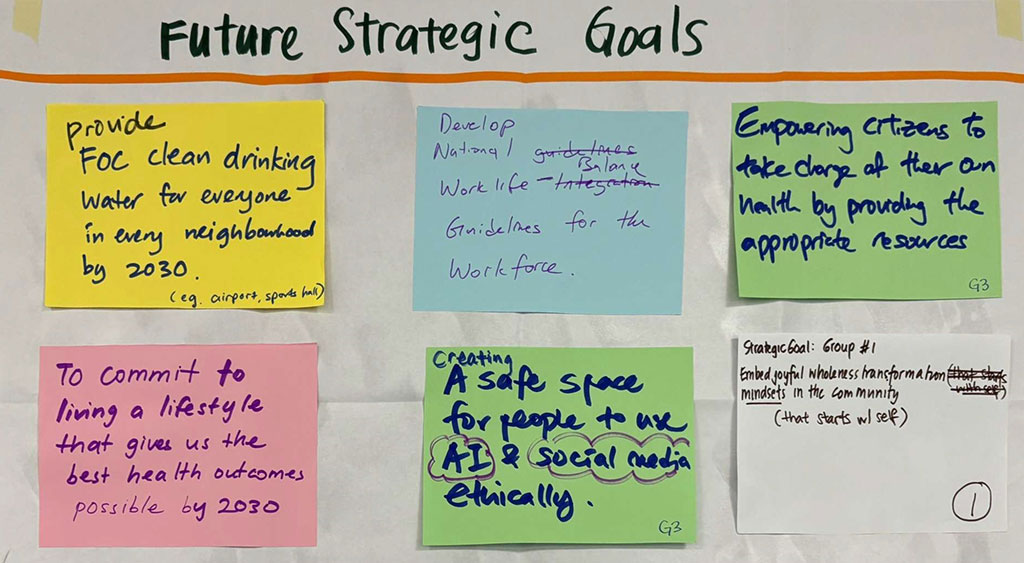
This was most evident during the group goal-setting phase. Teams articulated strategic goals and assessed them using evaluation grids with criteria of their own choosing. Goals ranged from “Providing free clean drinking water in every neighbourhood by 2030” to “Expanding access to social support spaces for youth and marginalised communities.” Collectively, we captured a wall of goals in colour-coded notes, as not just aspirations, but potential action plans.
Reflections: Facilitation as Partnership
In our short session, we embodied all five key principles that underpin the search conference model. With no pre-set outcomes, pre-surveys, or expert panels, the wisdom emerged from the room, whilst being guided towards creating strategic goals but never directed.
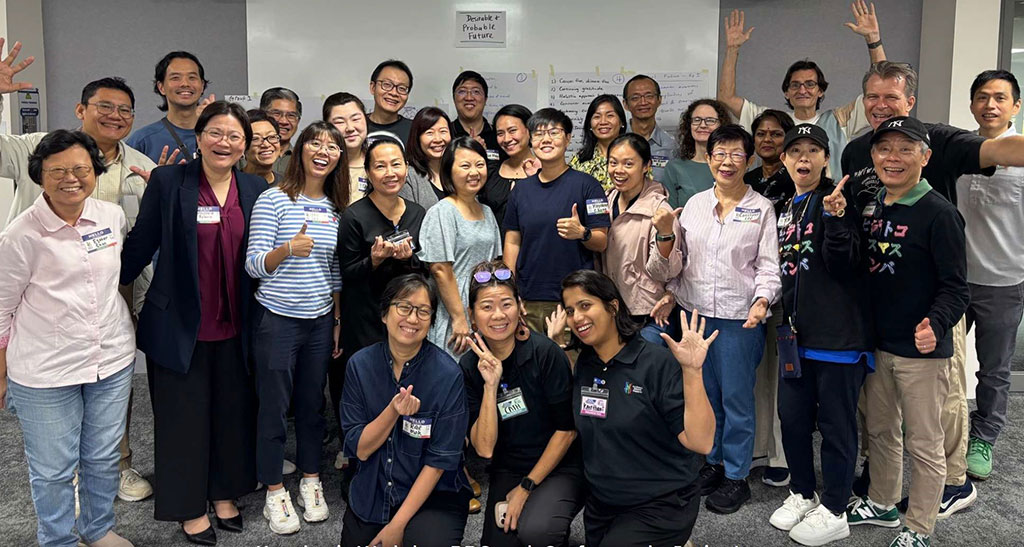
As the session closed, Janice invited us to consider how the role of a facilitator shifts in the search conference model. Instead of being the expert or organiser, the facilitator becomes a partner in process, holding the space, but not holding the answers.
Looking around the room, circles of quiet conversation, and many moments of laughter, it became clear that the future of facilitation lies not in tools, but in trust.
Janice reminded us that facilitation is both art and discipline. And perhaps, like the best search conference facilitators, we are not here to lead the room, but to help the room lead itself.
By Line
This article was written by Holly Naylor, a British content writer and relocation services manager specialising in sustainability who has lived in Singapore for 16 years. Connect with Holly on LinkedIn or email holly@theinspireandcreate.com.
Missed our Singapore Facilitation Conference 2025?
Don’t miss our next conference! Join our mailing list to be notified of our next conference at
https://www.surveymonkey.com/r/qr_code/SFC-next
OR email us at admin@fns.sg to join our Community of Practice (CoP).

Search
Categories
Recent Articles
Archives
- October 2026
- September 2026
- July 2026
- June 2026
- April 2026
- January 2026
- November 2025
- October 2025
- August 2025
- May 2025
- February 2025
- December 2024
- November 2024
- October 2024
- September 2024
- August 2024
- June 2024
- May 2024
- April 2024
- March 2024
- December 2023
- November 2023
- October 2023
- September 2023
- July 2023
- June 2023
- May 2023
- April 2023
- March 2023
- February 2023
- December 2022
- November 2022
- October 2022
- September 2022
- August 2022
- July 2022
- May 2022
- April 2022
- March 2022
- February 2022
- January 2022
- December 2021
- November 2021
- October 2021
- September 2021
- August 2021
- June 2021
- May 2021
- March 2021
- February 2021
- January 2021
- November 2020
- October 2020
- September 2020
- August 2020
- July 2020
- June 2020
- November 2019
- October 2019
- September 2019
- August 2019
- July 2019
- June 2019
- May 2019
- July 2018
- April 2018
- February 2018
- August 2017
- April 2017
- March 2017
- February 2017
- July 2016
- June 2016
- May 2016
- March 2016
- February 2016
- January 2016
- December 2015
- October 2015
- August 2015
- June 2015
- May 2015
- March 2015
- January 2015
- December 2014
- November 2014
- October 2014
- June 2012
- March 2012