We often think the goal is to avoid conflict. But sometimes, it’s where the real work begins.
Whether it plays out in the office or personal space, conflict is something we all encounter, but not always something we know how to handle well. The question is not whether we disagree, but how we disagree.

How do we recognise our own emotional triggers, de-escalate tension, and move conversations toward understanding and action?
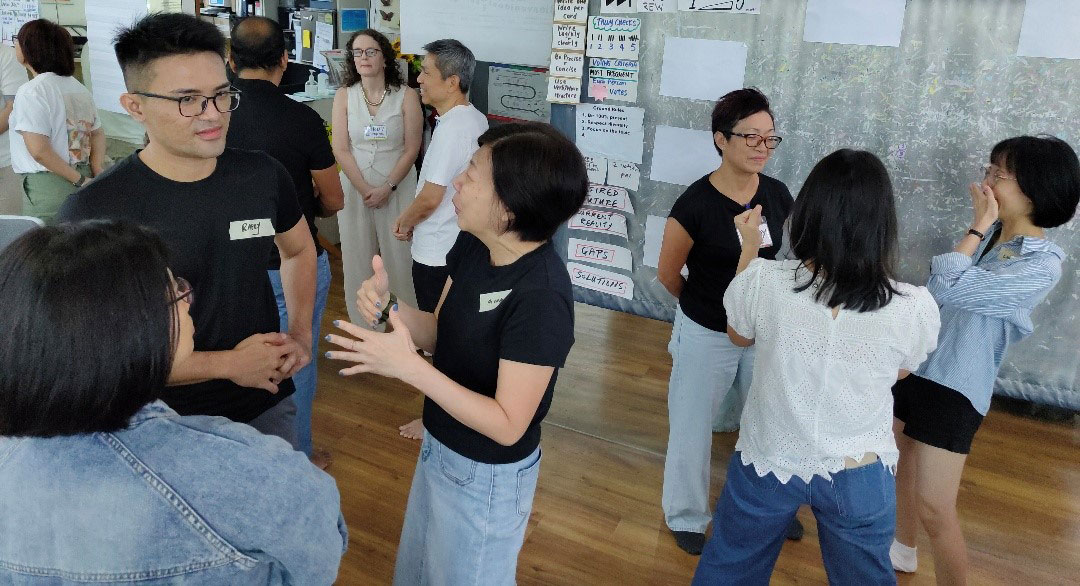
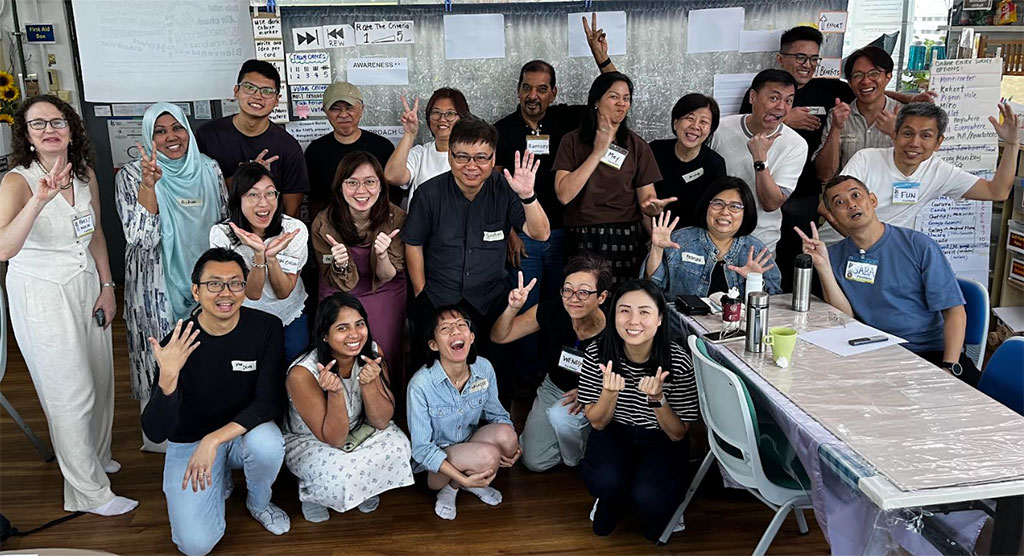
These were the questions we explored in the latest Community of Practice (CoP) hosted by the Facilitators Network Singapore (FNS) on September 20, 2025. The session, titled Disagree Without Drama©, was facilitated by Sabarudin (Saba) Hashim, a seasoned trainer and facilitator known for his calm presence and deep ability to hold space for sensitive, high-stakes dialogue.
From the moment the session began, it was clear we would not talk about conflict; we were going to practise how to work with it.
Reframing Conflict: From Emotion to Intention
We explored one of the core frameworks: The SEO framework for managing conflict.
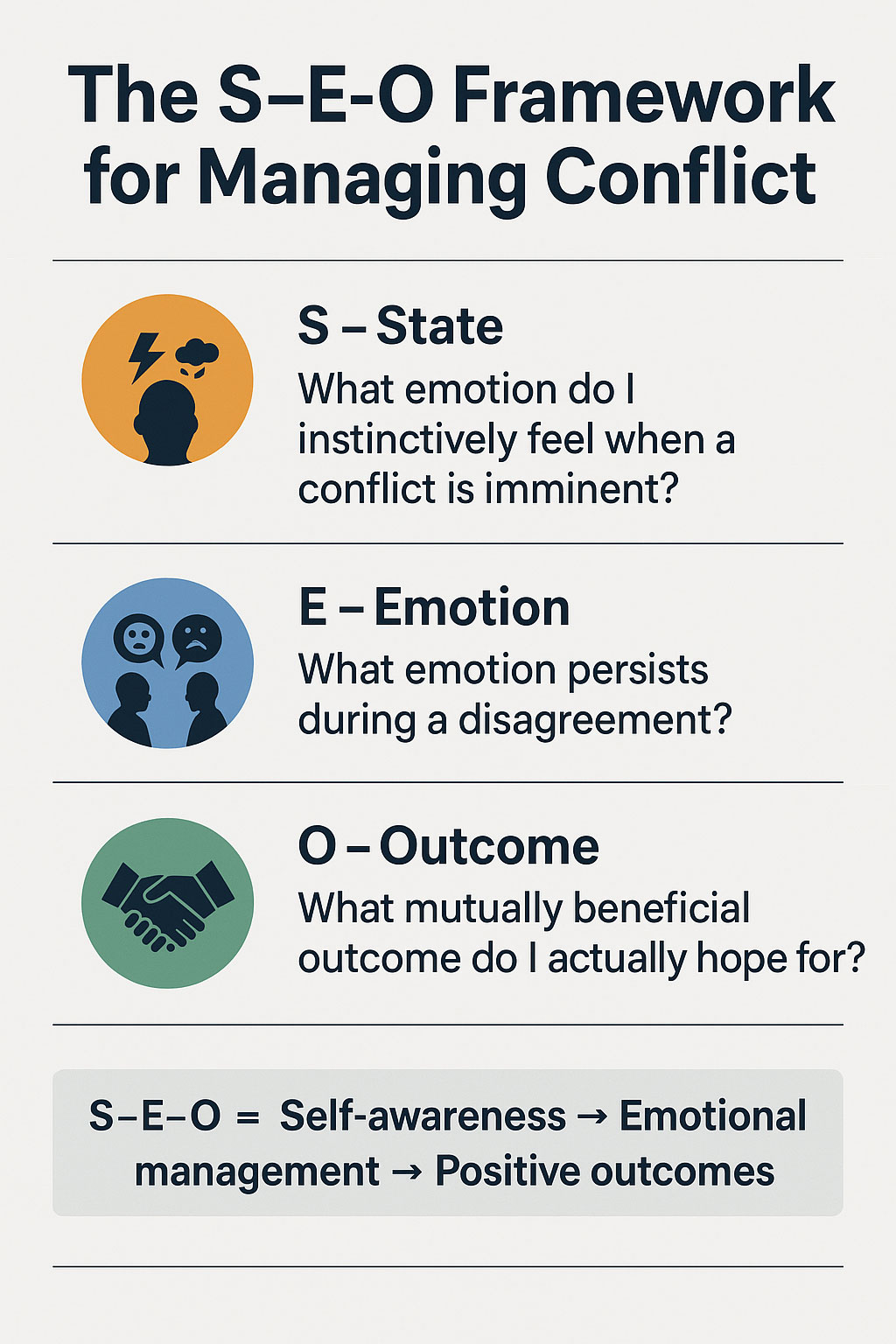
Saba encouraged us to stop and ask:“Am I focused on what I should have done? Or what I want to achieve now?”
This model helped many of us realise how often we skip past emotional self-awareness and jump straight to trying to fix things, often unsuccessfully. The difference between hot conflict (urgent, reactive) and cold conflict (quiet but unresolved) became especially clear.
As one participant recalled from a past team disagreement:
“I was calm on the surface, but beneath, I was closed off and defensive. Looking back, I wasn’t listening — I was just waiting for my turn.”
Quoting Ontario professor Jordan Peterson, Saba reminded us:
“Conflict delayed is conflict multiplied.”
The invitation? Don’t avoid conflict. Learn how to handle it well.
The AIR Method: A Conversational Reset
Next, we explored a micro-technique that proved surprisingly powerful:
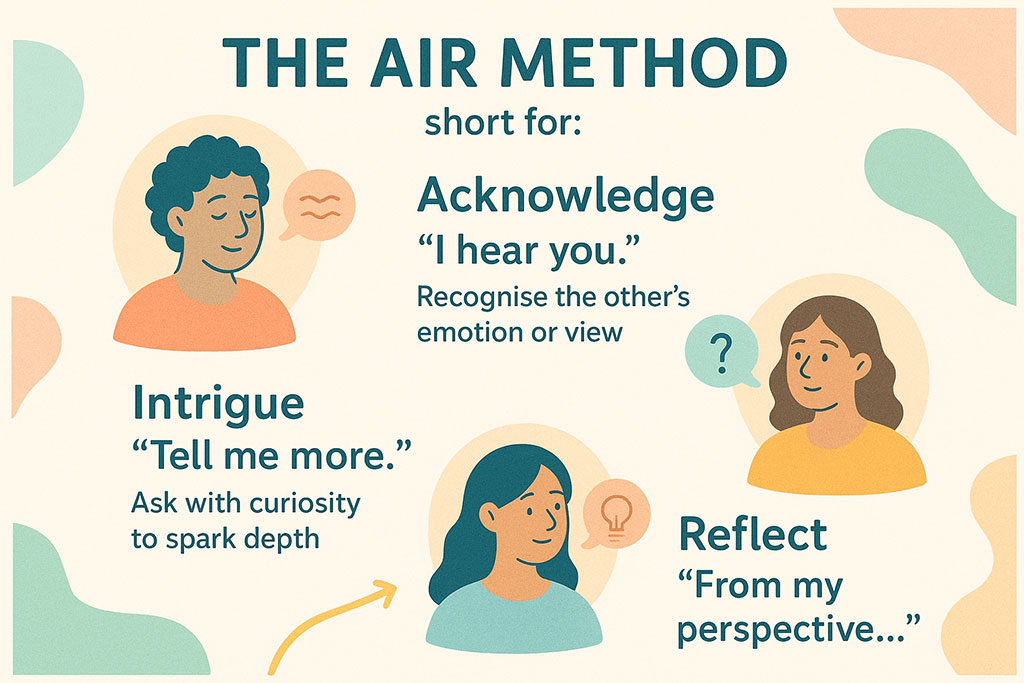
It sounds simple and that is the point. Used early and intentionally, AIR can transform reactive spirals into reflective conversations. And crucially:
Acknowledgement ≠ Agreement. It’s about understanding, not endorsing.
In one group debate exercise, we took opposing sides and did a simulated conflict on the topic of “I think remote work is just an excuse to shirk responsibilities.”
Instead of pushing back, we practised using the AIR technique:
“Sounds like you’ve had some tough experiences with that (Acknowledge). I’m curious — what led you to that conclusion? (Intrigue). From my side, flexibility has helped my team perform better (Reflect).”
As Saba noted:
“Each person needs to breathe first. Let them offload. Give the conversation AIR before anything else.”

The Tribunal: Conflict in Action
Towards the end of the session, we were immersed in The Tribunal, a role-play simulation with high emotional stakes. Our scenario involved a fictional commercial space travel company facing pressure to deliver on time despite internal safety concerns.
Roles included:
- A corporate executive (concerned about investor expectations)
- A pilot (refusing to fly with unresolved technical issues)
- HR, engineers, and regulators (all with competing priorities)
“All safety checks are complete,” one executive declared. “But we won’t alarm the board unless absolutely necessary.”
As the simulation unfolded, the tension was palpable. And so were the lessons:
- People felt ignored and isolated in decision-making.
- There was blame-shifting, lack of ownership, and fear of consequences.
- Some participants stayed silent, unsure when or how to speak up.
It became clear: conflict wasn’t the problem. The absence of clear process, emotion awareness, and psychological safety was.
What Helped Us Shift? Insights from the Sticky Wall
After the role-play, we moved to reflect. A colourful post-it wall helped surface what worked, and what didn’t in how we handled the simulation.
Under categories like Mindset, Method, and Momentum, insights included:
- “Be curious, not reactive.”
- “Refocus on shared goals.”
- “Suspend judgement to listen longer.”
- “Speak facts, not assumptions.”
Saba encouraged us to also reflect on our own inner stance.
“Sometimes, you’re not just responding to what’s said, you’re reacting to something unresolved in yourself.”
One of the most repeated insights:
“Sometimes people just need to purge. Let them.”
The Four Operations for Dialogue™: Subtract, Divide, Add, Multiply
From there, we transitioned into a hands-on application of the Four Operations for Dialogue™, using a mathematical metaphor to navigate tension:
| ➖ Subtract | What can we remove from the conversation to de-escalate tension? Examples:
|
| ➗ Divide | What should be separated to gain clarity? Examples:
|
| ➕ Add | What should be introduced to deepen the conversation?
Examples:
|
| ✖️ Multiply | What can we build on to create forward momentum? Examples:
|
This framework gave everyone a practical lens to use in real conversations, one that balanced logic with empathy.
Three A’s, Three M’s: Practical Wisdom to Take Forward
Saba closed the session by sharing a few final tools:
The Three A’s representing the 3 intentional shifts within a productive conflict
- Awareness → From blind spots to clarity
- Approach → From reaction to intention
- Action → From conflict to common ground
The Three M’s representing the 3 iterative choices at each stage of a productive conflict
- Mindset – Choosing how i show up (e.g. curious, concern, calm, etc)
- Method – Choosing one/more technique that complements my intended approach (e.g. of approaches = consensus, compromise or collaborate)
- Momentum – How we jointly move forward to next milestone (be it an agreement or a decision)
Personal Reflection: A Conversation I’d Approach Differently
During the session, I kept thinking about a colleague who always logs off exactly at 5:30pm and tells clients she will respond the next day. In our service-based environment, that has created friction. We have disagreed a few times, and I have struggled with how to give feedback without sounding pushy.
Knowing what I know now, I would approach it with more curiosity. Instead of focusing on what I think she should do, I would apply the AIR method. I would acknowledge her boundaries, ask gently why taking a few moments extra to respond to a client is an issue, and reflect on how it impacts the rest of the team.
I may not fully agree, but I would be listening. And that might change the tone of the conversation completely.
Final Reflections: Giving Conflict More AIR
Rather than something to fear, disagreement can be a signal and a cue that something matters enough to be voiced. It is an indication to attend to something that is not right and something that we need to pay attention to in order to improve something. If we respond with curiosity rather than control, presence instead of panic, we can open up possibilities instead of shutting them down.
My own reflection? Next time I feel defensive, I’ll pause. I’ll ask:
“What am I trying to subtract? Divide? Add? Multiply?”
And maybe I’ll try giving the conversation a little more AIR.
About the Facilitator
Sabarudin (Saba) Hashim is a INIFAC Certified Master Facilitator® with more than 20 years of experience as a trainer and 14 years as a process facilitator and panel moderator. He is Asia’s first INIFAC-Certified Virtual Facilitator® (2020) and a INIFAC Certified Master Facilitator® (2022). Saba is currently an associate trainer at Civil Service College, and volunteers with OnePeople.SG, facilitating sensitive dialogues around race, ethnicity and religion.
By Line
This article was written by Holly Naylor, a British content writer and relocation services manager specialising in sustainability who has lived in Singapore for 16 years. Connect with Holly on LinkedIn or email holly@theinspireandcreate.com.
Wished you were at this CoP?
Don’t miss our next CoP. Check our website at https://fns.sg/forums/ for updates and details.
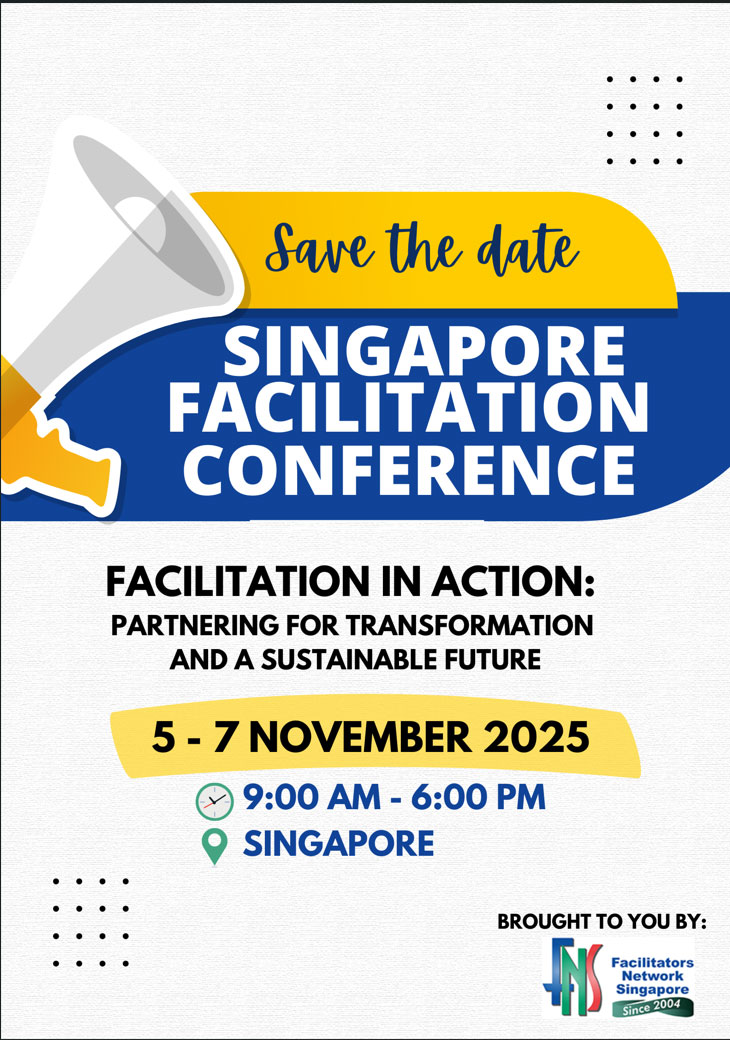
And you do not want to miss our upcoming conference on
5-7 November 2025
“Facilitation in Action: Partnering for Transformation and a Sustainable Future”.
Check our website for more information and registration at https://fns.sg/singapore-facilitation-conference-2025/.