Being a facilitator saved my life.
This might sound like an exaggeration, but I can assure you that it’s not.
In September 2021, one month before the end of my full-time employment as a social worker, Janice Lua, the cofounder of Facilitators Network Singapore (FNS), offered me a scholarship to attend their SPOT on Facilitation training.
Finally, on 6 October 2021, I finished my contract as a social worker. Beyond the chirpy “Hallelujah!” I felt, I was still desperately looking for my next role. I thought it would be fast. After all, I was 26, and social work was always looking for more people. What resulted was a long drawn two and a half years of job searching, and it was after more than 300 applications, and over 60 interviews, before I finally got the next job.

Fortunately, during that time, learning process facilitation under the tutelage of Janice and Prabu, gave me a regular income beyond what I expected. Yes, it was only a few hundred dollars a month. But if you were like me, carrying four bananas out a day, and feeling the stomach rumble as you sat alone in central CBD, you would not have begrudged those few hundred dollars.
Start before you’re ready
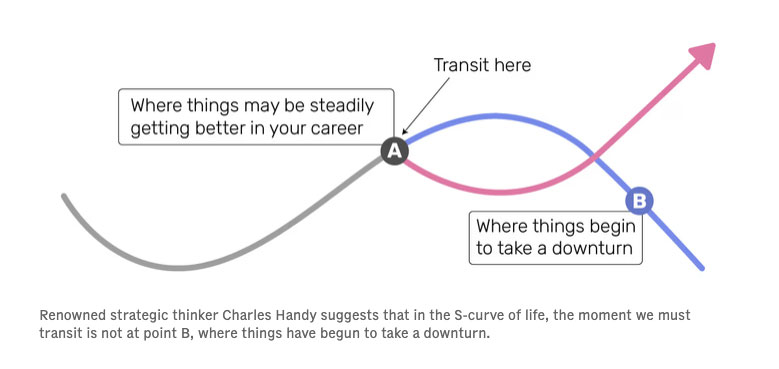
My story has a point. Upgrade before you feel ready to, rather than when you need to. We sometimes assume that a career transition would take place tidily.
- Take a course.
- Find the next role.
- Quit your current role.
The truth is that any transition often takes longer, and is more complex. For example, as a process facilitator, I was grateful that Janice gave me the chances to apply those skills, even though I had no experience. I took two years before I eventually had the chance, and could be trusted to lead a facilitation.
Humbling myself
More than that, becoming a process facilitator was a process in humbling myself again. I’m the first to admit that I was a very proud man. After all, I had achieved some things with life, and thought that process facilitation wasn’t that hard.
But I was the first to find out that in process facilitation, details mattered. I faced a difficult time getting used to the fact that I had to draw lines, use the right colored markers, and write legibly so that participants could have the best facilitated experience.
In fact, I even failed my Certified Competent Facilitator (CCF) certification twice.
As someone who was struggling with money at that point in time, each new try cost me money that I would have wanted to use for my own living expenses. After all, I was only earning an average of less than $2000 a month, and the money that I’d spent on certifying myself seemed like a poor choice.
There was one point where I just thought, what’s the point? I could just quit.

But I learnt to recognise that any qualification worth having was going to take time and effort. Even if I quit this, and went onto another programme, there was no guarantee that programme would work too.
I finally learnt to humble myself to accept that I still had things to learn and improve made me stick with the process, even though it was extremely painful.
It’s not about you
The focus was on the participant, not on me, the facilitator. As someone who’d come from the training and speaking industry, the focus was always on the speaker’s content, and not necessarily what the audience needed. But in process facilitation, it was more crucial that participants, and ultimately, that the sponsor got what they needed.
I remember one early session where I was being observed. In that focus group discussion, I had tried to shape the participant’s point by asking yes/no questions. After the session, I got feedback that the discussion point was not about what I thought. It was about what the participant thought. Trying to guide them down a certain path with closed questions might not always be the best.
But what was also important in process facilitation was paying attention to the individual, and also the wider group dynamics. For example, in the early small group facilitation sessions that I did, I often wondered why some discussions flowed so much better, whereas others seemed a little more stuck.
When some people sat together, they just couldn’t seem to get the conversation flowing, no matter how hard I tried. I would try to break the ice, crack a joke, but it often felt out of place.
Reading the room
I later realised that this was a common situation, and that the facilitator should be aware, and make efforts to intervene and change the dynamics of the group. After this realization, I made a deeper effort to read the room, and sense where the energies of different group participants lay, and how to quickly put complementary energies together.

It started from simply observing what participants were interested in talking about. I would also take note of those who were more talkative, and seemed better able to talk to strangers, without any prompting. I would then see who tended to be quieter, and rearrange the pairings accordingly.
Learning to deal with the chilis in the conversation
After that initial pairing, when the discussions started, I would often try to note where the points which elicited the most heated responses were. Sometimes, these points were controversial (such as suggesting the government to reduce the GST). My younger self would have shy away from these points. I would have been afraid of how to hold space for such controversy.
I would offer myself a cop-out, telling myself that it was far better to get a wide range of points, even if they might be shallower. But I slowly realised that wasn’t ideal.
Process facilitation taught me to be more ‘heat-resistant’, and to be less afraid of holding space for controversial points. A wiser and older facilitator, Dr Douglas O’Loughlin, likes asking clients, “how many chilis would you like in the session?” It refers to how many difficult conversations clients would like to address through the process. But it also naturally assumes that facilitators are adept at ‘dealing with chilies’, which might not always be the case. How does one learn?

It might simply be about courageously approaching these situations, and telling oneself,
no matter what happens, I will have the skills to deal with it.
And even if I don’t know, it will still be okay.
Process facilitation as a metaphor for life
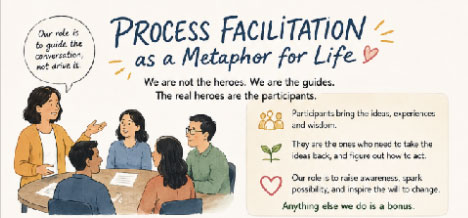
In the first lesson I had in learning how to be a facilitator, Janice and Prabu often reminded us that we were guides, and not the heroes of the conversation. The real heroes were the participants. They were the ones who needed to take the ideas back, and figure out how to act on them.
Our role was to raise enough awareness within participants of these issues, and to make the them feel like they could and wanted to make those changes they had discussed. Anything else we did was a bonus.
Often, after a long day of facilitating, I’d be zoning out on the bus, and wondering if I really did make a difference. Sure, there were some laughs, and possibly some deep conversations.
But what changed? Did anything even change? Asking these questions can feel deeply existential, and leaves one questioning about the value process facilitators bring.
What I’ve come to learn is that the act of simply sitting in the same space, and having a conversation, is not something that takes place by chance. It is difficult. One only needs to look at the wars and conflicts happening everywhere else to realise that this peace we have in Singapore is fragile, and should not be taken for granted.
As process facilitators, we are guides, and I think also, guards against the natural human instinct to group together with those we find most like us.
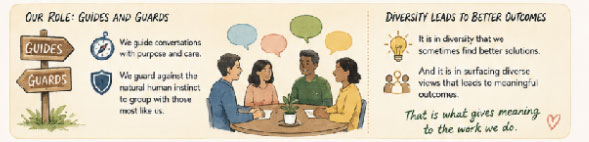
But it is in diversity that we sometimes find better solutions. And it is in surfacing diverse views that leads to meaningful outcomes, that has helped me to find continued meaning in process facilitation.
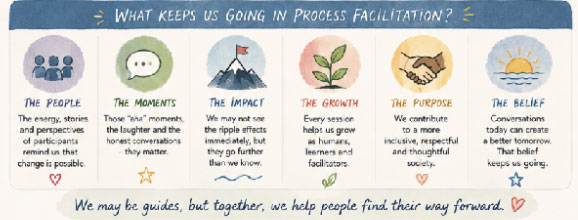
What keeps you going in process facilitation?
For me, it’s the people, the ‘aha’ moments and the belief that the conversations we facilitate can make a difference in transforming people, teams and organisation.
By Line
This article is written by John Lim.
John runs Media Lede, a content agency designing annual reports and publications. In 2025, he became one of the youngest Certified Competent Facilitators when he became certified at the age of 29.
Curious about our SPOT on Facilitation training?
Check out why our SPOT on Facilitation can transform the way you facilitate meetings and help you transit from full-time employment with a solid set of skills: